A good entertainment unit rarely announces itself. It just fits, holds what it needs to, and lets the rest of the room breathe. Getting there, though, usually comes down to one choice made early: buy something ready-made, or have a piece built for the space you actually have.
Neither is the obvious winner. A stock unit can be exactly right for one living room and a constant source of small frustrations in the next. What follows is a practical look at when each option earns its place, so you can match the decision to your room rather than the other way around.
What Actually Separates the Two?
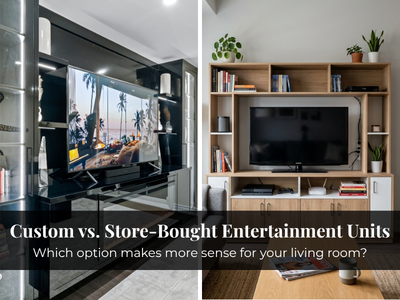
A store-bought unit comes in fixed dimensions, with set configurations and a limited range of finishes. You choose from what already exists. A custom unit works the other way around: it starts with your wall, your TV, your storage, and the way you want the room to feel, then gets built to match.
That difference sounds obvious, but it drives almost everything else in the decision.
Store-Bought Entertainment Units: Where They Make Sense?
There’s nothing wrong with buying off the shelf, and in plenty of situations it’s the smarter call.
The upfront cost is usually lower, and you can often have something in your living room within days. If you’re renting, moving soon, or furnishing a first condo in North York, a ready-made unit that you can pick up, assemble, and later resell has real practical value. When your wall happens to suit standard furniture dimensions and your storage needs are modest, a stock piece can do the job perfectly well.
The trade-offs show up when your space doesn’t cooperate. Fixed widths leave gaps against longer walls. Predefined shelving may not hold what you actually own. Cables tend to be an afterthought, and anything unusual, a recessed nook, a sloped ceiling, a fireplace beside the TV, quickly becomes something you work around rather than design for.
What Custom Entertainment Units Solve?
This is where a purpose-built unit starts to justify itself, and it’s less about looking better than about removing compromises.
- Exact fit is the clearest advantage. Rather than choosing the closest available size and hoping, the cabinetry is drawn to your wall down to the inch. That matters as much in a narrow Toronto condo, where every centimetre counts, as it does in a wider Vaughan living room, where a stock unit can look stranded against a long wall.
- TV integration gets considered as part of the whole. Screen size, viewing height, and the cabinetry around it are planned together, so the television reads as part of the wall instead of a black rectangle balanced on a shelf.
- Storage is designed around your belongings. Drawers, closed cabinets, and open shelving get sized for what you keep, whether that’s a growing collection of games, hidden media components, or things you’d rather not see at all. The mix of open display and concealed storage is decided by you, not by whatever the manufacturer defaulted to.
- Cable management is easier to get right when it’s planned before anything is built. Routing power and connections through the cabinetry at the design stage produces a far cleaner result than threading wires through a finished piece later.
- Fireplace integration is one of the strongest cases for going custom. When a TV, fireplace, and cabinetry share a wall, treating them as one composition, rather than three separate objects, is what keeps the room from feeling cobbled together.
Custom also earns its keep in awkward spaces: floor-to-ceiling walls, shallow depths, tight alcoves, or anything that standard furniture simply wasn’t made for. Where it helps, integrated lighting can highlight display areas or soften the screen’s glow. And finish choices open up considerably, from painted MDF and thermofoil to wood veneers or a high-gloss lacquer, letting the unit sit naturally with the rest of the room.
If your needs point toward a genuinely built-in solution rather than a piece of furniture, that’s the moment to talk with a team that designs and builds custom entertainment units around the actual room.
Custom vs. Store-Bought: The Key Differences
| Factor | Store-Bought | Custom |
|---|---|---|
| Upfront cost | Lower | Higher |
| Fit to wall | Standard sizes | Built to exact dimensions |
| Storage | Predefined | Planned around your needs |
| TV integration | Left to you | Designed in |
| Cable management | Usually retrofitted | Planned before build |
| Fireplace integration | Difficult | Handled as one design |
| Finishes | Limited range | Wide selection |
| Best suited for | Short-term, standard spaces | Long-term, specific rooms |
Is a Custom Entertainment Unit Worth the Higher Cost?
It costs more upfront, so the honest answer is that it depends on what you’re solving for.
Custom tends to pay off when the wall has unusual proportions, storage requirements are specific, the TV is large, a fireplace is involved, cable routing matters to you, or the piece is meant to stay in the home for years. If you want a particular finish or layout that stock simply doesn’t offer, that’s another point in its favour.
Store-bought remains the sensible choice when budget leads the decision, the living situation is temporary, portability matters, or standard dimensions already work. Paying for custom only makes sense when the customization actually addresses a problem you have.
What to Weigh Before You Choose?
Before comparing price tags, it helps to look honestly at your own situation. A few questions tend to settle the matter quickly:
- How long do you plan to stay? A few years leans stock; the long haul leans custom.
- Does the wall have odd dimensions, awkward depth, or space a standard unit would leave empty?
- How much storage do you genuinely need, and how much of it should stay out of sight?
- Are you working around a fireplace, soundbar, gaming console, or several media devices at once?
- Does hidden cable routing matter to you, or can you live with wires on view?
- Should the unit tie into existing cabinetry or the overall look of the room?
If most of your answers point to standard sizes and short-term simplicity, off the shelf will likely serve you well. The more your answers involve integration, concealment, or a wall that refuses to cooperate, the more a built-in solution starts to make sense.
Which Option Fits Your Living Room Best?
Picture how the room will function five years from now. If a stock unit fits the wall, holds what you need, and suits how long you’ll be there, buy it with confidence. If you keep running into gaps, wasted wall space, cable clutter, or a fireplace that never quite works with the TV, those are the signs that a built-in solution will serve you better over time.
For homeowners across Toronto, Vaughan, North York, and the wider GTA who are ready to plan the space properly, we can help. With more than 25 years of custom design, fabrication, and installation behind us, we handle everything from the first measurements to the finished wall, backed by a 5-year limited warranty and a lifetime warranty on hardware. Many of our projects are completed in as little as four weeks.
If you’d like to get the proportions right and plan your storage before anything is built, call us at 416-727-9795 to talk through your living room with our team.